

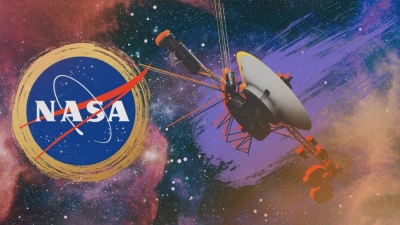
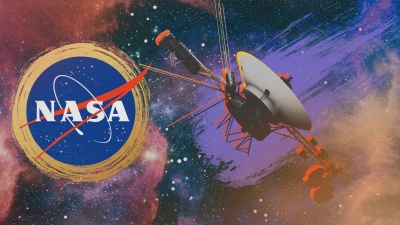
Out there in the absolute darkness where the frost reaches the limit where matter itself "paralyzes," Voyager 1 is fighting the most critical battle of its life. The most distant human-made object in history is now 25.4 billion kilometers away, exploring the unmapped interstellar vacuum. There, on the edge of "nothing," NASA is preparing an operation that resembles a science fiction scenario: the "Big Bang" plan.
The sacrifice in the... darkness
A few days ago, NASA announced a difficult decision. It sent a command to the spacecraft to deactivate one of its last functioning instruments, the Low Energy Charged Particle (LECP) experiment. For nearly half a century, the LECP served as our "eyes" on the invisible particles and cosmic rays that permeate our galaxy. Its deactivation was not a choice, but a necessity. Voyager 1 is powered by a declining plutonium source that loses about 4 Watts of power every year. In an environment where the temperature touches -62 degrees Celsius, energy management is a tightrope exercise in survival. If the fuel lines freeze, the spacecraft will lose the ability to point its antenna toward Earth, and the silence will be final.
The risky bet of the "Big Bang"
NASA engineers at the Jet Propulsion Laboratory (JPL) are not ready to give up on the legend. The "Big Bang" plan constitutes a total, simultaneous restructuring of the spacecraft's systems. The idea is bold: to deactivate certain legacy devices and activate alternatives that consume less energy, ensuring the spacecraft remains warm enough to function but "alive" enough to transmit scientific data. Voyager 2, which is located slightly closer to Earth and possesses slightly more energy reserves, will serve as the "guinea pig" this May and June. If the experiment succeeds, it will be applied to Voyager 1 in July. If everything goes according to plan, the "Big Bang" could not only keep the craft operational until its 50th anniversary but might even allow for the reactivation of instruments previously considered "lost."
The Greek signature
In this epic endeavor, the Greek presence is decisive. Stamatios Krimigis, the leading academic and Principal Investigator of the LECP instrument, described the machinery's endurance with awe. "The stepper motor functioned flawlessly for nearly 49 years and over 8.5 million steps," he noted characteristically. The fact that a machine designed in the 1970s continues to operate at temperatures that would destroy any modern smartphone is, as he says, "what dreams are made of."
The end of an era
The spacecraft's fault protection resembles, according to mission manager Kareem Badaruddin, an acrobat's safety net. NASA is trying to keep Voyager 1 on the "trapeze" for as long as possible. Even if the "Big Bang" fails, the two Voyagers have already written history…
www.bankingnews.gr










Σχόλια αναγνωστών